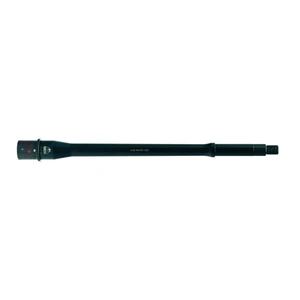
What Every Duty Series Barrel Goes Through
- Drill and pull-ream 4150 CMV bar is gun-drilled, then pull-reamed from the chamber end to the bore diameter for its cartridge, held to ±.001″ and checked on a profilometer.
- Button rifle A carbide button is pulled through from the chamber end to form the grooves (six on most barrels) at the twist for the cartridge: 1:8 on 5.56, 300 Blackout, and 7.62x39; 1:10 on .308 and 9mm; 1:16 on 350 Legend, 400 Legend, .450 Bushmaster, and 10mm; 1:14 on .458 SOCOM; 1:3 on 8.6 Blackout. Bore and groove are air-gauged.
- Stress relieve and qualify The rifled blank is stress relieved so the profile turning and the heat of use do not move the bore, then the outside is qualified true to the bore so every later cut references the same axis.
- Turn the profile The chamber journal, the profile, the gas journal and its shoulder, and the muzzle shoulder are turned true to the bore; the muzzle is threaded, gauged, and crowned at 11°.
- Chamber The chamber is cut to a go gauge and checked on every barrel.
- MPI and nitride The machined barrel is 100% wet magnetic-particle inspected for surface and near-surface flaws, then salt-bath QPQ nitrided inside the bore and out, hardening the surface while adding virtually nothing to it.
- Port, extension, headspace After nitride, the gas port is drilled and reamed to the size set for that length and gas system, the extension is torqued to 150 ft-lb and pinned, and the assembly is headspaced with a go/no-go gauge for its cartridge. Blowback barrels get their indexing pin pressed in instead.
- Mark The Faxon shield, order number, and cartridge and twist are laser-engraved.
AIR-GAUGED
Bore and groove diameters measured with air gauges to ±.001″ after reaming and after rifling.
HEADSPACED
Extension installed, torqued to 150 ft-lb, pinned, and checked with a go/no-go gauge on every barrel.
100% WET MPI
Every barrel is wet magnetic-particle inspected, the more sensitive method, right before nitride.
What Reviewers and Owners Say
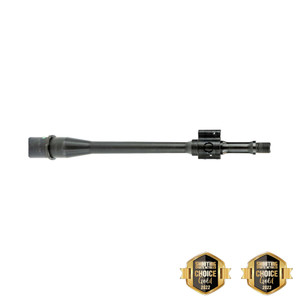
Faxon’s AR-15 and AR-10 barrels have been voted Favorite Aftermarket Barrel by Shooting Sports Retailer every year since 2022 — the Gold Award, the top honor in the category, and it is an award for Faxon barrels as a whole, not one series. Faxon also took the Tactical Retailer Gold Award in the same category in 2025. The 16″ Gunner alone carries hundreds of five-star reviews across FaxonFirearms.com, Primary Arms, OpticsPlanet, Brownells, and MidwayUSA, and Pew Pew Tactical’s reviews of the 16″ Gunner, 16″ Pencil, and 350 Legend barrels are linked from each product page along with that barrel’s own owner reviews.
Finish the build
Gas Blocks, Gas Tubes, BCGs, Uppers, and Suppressors for Duty Series
A low-profile gas block in the journal diameter (.625″, .750″, or .875″) and a gas tube in the system length finish any gas-operated Duty Series barrel; the adjustable block is the pairing for suppressed builds. 5.56, 300 Blackout, and 350 Legend run a standard 5.56 bolt carrier; 7.62x39 takes a 7.62x39 bolt; the .458/.450 bolt for the big bores, the 6.8 SPC / .224 Valkyrie bolt for 400 Legend, and the 9mm and 10mm blowback carriers are in Faxon’s BCG line. The Big Bore upper is required for .450 Bushmaster and .458 SOCOM and recommended for 350 Legend. Faxon’s low-backpressure HARMONIX® and CORESYNC® suppressors and the MuzzLok® mount round it out.
Adjustable Gas Blocks › Gas Tubes › Bolt Carrier Groups › Upper Receivers › Muzzle Devices › Suppressors ›
Duty Series FAQs
What is the difference between Duty Series, Combat Series, Match Series, and MATCH-X?
Duty Series is 4150 CMV chrome-moly-vanadium steel, button rifled, and QPQ nitrided inside and out: the hardest-wearing, most corrosion-resistant barrel Faxon makes and the one built for a rifle that is carried, run hot, and cleaned when there is time. Combat Series is the same 4150 CMV built the classic way, with a chrome-lined bore and a manganese phosphate exterior, in M4, medium taper, and Gunner configurations. Match Series is 416-R stainless with 5R rifling and a nitride finish; MATCH-X is 416-R honed to 8 Ra before rifling and lapped to 16 Ra after, left uncoated. Duty and Combat are the working barrels; Match and MATCH-X are the precision barrels.
Is 4150 CMV better than 4140?
For a barrel, yes. 4150 carries about 0.50% carbon against 4140’s 0.40%, plus vanadium, which gives it higher strength and better wear resistance at the temperatures a barrel throat sees during fast strings. That is why the military M4 and M16 barrel specification calls for 4150 and why Faxon uses it for every Duty Series barrel. 4140 is fine steel for a barrel that is never shot hot; 4150 is the steel for one that is.
Is the nitride finish inside the bore?
Yes. Salt-bath QPQ nitride is a diffusion treatment that hardens the surface of the bore and the exterior while adding virtually nothing to it, a few ten-thousandths of an inch, roughly a tenth the width of a human hair or about the diameter of a single red blood cell, and there is no plated layer to wear through. It gives the barrel its corrosion resistance and matte black finish, and it needs little to no break-in.
Why nitride instead of chrome lining?
Chrome lining still has its place: it was developed for machine guns, holds up best under the extreme, sustained heat of belt-fed and full-auto fire, and some military and agency contracts still specify it. For the vast majority of shooters, including semi-automatic rifles run hard in classes and matches, nitride does what they need and more: it hardens the bore while adding virtually nothing to it, a few ten-thousandths of an inch, it treats the exterior as well, it resists corrosion, and it needs little to no break-in.
Which profile should I choose?
Pencil is the lightest (1.20 lb at 16″ in 5.56) for a carbine that is carried more than it is fired in long strings. Gunner is the balanced middle (1.37 lb) and Faxon’s most popular barrel. SOCOM is the heavy-duty M4 profile (1.73 lb) with the most heat capacity for a rifle that runs suppressed and hot. HBAR is the stiff bench and bipod profile (2.06 lb). Big Bore and Light Tapered are the profiles for their cartridges. Every profile in the same cartridge and length shoots the same ammunition to the same velocity; the difference is weight, balance, and how many rounds it takes to heat up.
What size gas block and which gas tube do I need?
The gas block matches the journal diameter in the product’s specifications: .625″ on 5.56 Pencil and Gunner barrels, .750″ on SOCOM, HBAR, 300 Blackout, 7.62x39, 350 Legend, and .308, .875″ on .450 Bushmaster, .458 SOCOM, 400 Legend, and 8.6 Blackout. The journal is 1.9″ long on Gunner, SOCOM, Big Bore, and AR-10 barrels and 1.1″ on Pencil and HBAR; any standard low-profile block fits either. The gas tube matches the gas system length in the product name: pistol, carbine, mid, or rifle. Blowback 9mm and 10mm barrels use neither.
Do I need an adjustable gas block?
Not for an unsuppressed rifle on factory ammunition: every Duty Series barrel is ported to cycle a standard buffer as-is. An adjustable block earns its place when the barrel will run suppressed, when it will switch between very different loads, or on the short mid-length barrels (11.5″ and 12.5″ mid-length), which carry a large port for their short dwell and shoot noticeably softer with the gas metered. Faxon’s adjustable blocks meter the port with no screw in the gas path.
Is the barrel extension installed and headspaced?
Yes. Every Duty Series barrel ships with its extension torqued to 150 ft-lb, pinned, and headspaced with a go/no-go gauge for its cartridge, so it drops into a mil-spec upper with a standard barrel nut and any in-spec bolt of the right pattern. The 9mm and 10mm blowback barrels have no extension; they seat in the upper on a 1.000″ receiver journal with an indexing pin, headspaced to a go gauge.
Which barrels need a special bolt, upper, or magazine?
5.56, 300 Blackout, and 350 Legend run a standard 5.56 bolt carrier group and standard AR-15 magazines (350 Legend uses its own magazines). 7.62x39 needs a 7.62x39 bolt and magazines. 400 Legend uses a 6.8 SPC / .224 Valkyrie bolt. .450 Bushmaster and .458 SOCOM use Faxon’s .458/.450 bolt carrier and require the Big Bore upper receiver; the Big Bore upper is a recommended option for 350 Legend. .308 and 8.6 Blackout are AR-10 barrels for a DPMS Gen 1 / LR-308 upper and bolt. 9mm and 10mm blowback barrels need a Glock®-pattern PCC lower and Faxon’s 9mm or 10mm blowback bolt carrier.
Can I pin and weld a 14.5″ or 13.9″ barrel to 16″?
The 14.5″ and 13.9″ barrels are made with that in mind: the 1/2x28 muzzle takes any pin-and-weld-friendly device, and a device of the right length brings the permanently attached overall length past 16″. Faxon does not pin and weld barrels or advise on a specific configuration; the work should be done by a gunsmith, and the measurement is yours to confirm. MuzzLok® is a quick-detach suppressor mount and is not intended for pin and weld.
What twist rates do Duty Series barrels use?
1:8 on 5.56 (stabilizes 55 through 77 gr), 300 Blackout (110 gr supersonics through 220 gr subsonics), and 7.62x39; 1:10 on .308 Win and 9mm; 1:16 on 350 Legend, 400 Legend, .450 Bushmaster, and 10mm; 1:14 on .458 SOCOM; and Faxon’s original 1:3 on 8.6 Blackout, which spins the heavy subsonics fast enough to expand on game.
What are Integral Series and Pinned Gas Block barrels?
Both are Duty Series barrels with one more operation. Integral Series barrels have a permanently attached, integral muzzle device; Pinned Gas Block barrels ship with a low-profile gas block pinned to the journal at the factory. They are cross-listed here because they are Duty Series steel and process, and each has its own category with its own details.
Where are Duty Series barrels made, and what is the warranty?
Every Duty Series barrel is made start to finish in Faxon’s plant in Greater Cincinnati, Ohio, from certified 4150 CMV bar stock, on Faxon’s machines, to Faxon’s prints, and is covered by the Faxon Lifetime Guarantee.
Dimensions and process steps are from Faxon engineering prints and inspection routers; weights are nominal. Prices are MSRP and subject to change. Gas blocks, gas tubes, bolt carrier groups, and muzzle devices sold separately. Award: Shooting Sports Retailer Choice Awards, Favorite Aftermarket Barrel, Gold, 2022–2025; Tactical Retailer Choice Awards, Gold, 2025.