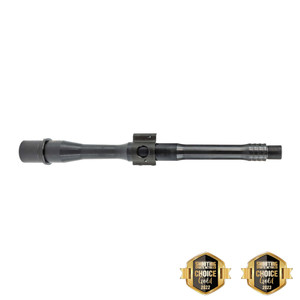
300 Blackout, By the Numbers
300 Blackout was developed by Advanced Armament Corporation with Remington and accepted by SAAMI in January 2011 for one purpose: a .30-caliber cartridge that runs in a standard AR-15 bolt, magazine, and upper, burns its full charge in a very short barrel, and shoots heavy subsonic bullets quietly through a suppressor. It is the 5.56 case shortened and necked up to .308, which is why only the barrel changes, and why a 300 BLK round will chamber in a 5.56 barrel with catastrophic results. Keep the two in separate magazines.
The cartridge lives two lives. Subsonic loads, 190 to 220 gr at about 1,050 fps, are the reason it exists: suppressed, they are as quiet as a centerfire rifle gets. Supersonic loads, 110 to 125 gr at 2,000 to 2,400 fps depending on barrel length, turn the same gun into a 200-yard carbine. Hornady publishes its 300 BLK figures from a 16″ barrel; from a 7.5″ expect subsonics within 50 fps of those numbers and supersonics roughly 300 fps slower, because a subsonic load is fully burned in a few inches and a supersonic load is not.
Faxon rifles the Duty Series 300 BLK barrels at 1:8, the twist that stabilizes the full range of jacketed 300 BLK ammunition, from 110 gr V-MAX to 220 gr subsonics, from 7.5″. Shooters who run the heaviest monolithic subsonics, 240 gr and up, should look at Faxon’s 1:5 Match Series 300 BLK, which is Faxon’s best-selling barrel for exactly that reason.
Hornady factory data — 16″ test barrel
| Load | Bullet | Muzzle velocity | Muzzle energy | Test barrel |
| Hornady BLACK | 110 gr V-MAX | 2,375 fps | 1,378 ft-lb | 16″ |
| Hornady American Gunner | 125 gr HP Match | 2,175 fps | 1,313 ft-lb | 16″ |
| Hornady Subsonic | 190 gr Sub-X | 1,050 fps | 465 ft-lb | 16″ |
Source: Hornady product pages. From the 7.5″ and 10.5″ expect subsonics roughly 20–50 fps slower and supersonics roughly 200–300 fps slower; estimates, not Faxon chronograph figures. Hornady specifies a 900 fps expansion floor for Sub-X, which a 7.5″ clears with margin.
Duty Series 300 Blackout Barrels
All 1:8 twist, 4150 CMV, QPQ nitride inside and out, 5/8x24 muzzle. Weights are nominal; prices are MSRP.
What You Need to Build It
Standard 5.56 bolt carrier group, upper, and barrel nut; 300 BLK-specific magazines are recommended for heavy subsonics. All three barrels take a .750″ gas block on a 1.9″ journal; the 7.5″ and 10.5″ take a pistol-length gas tube and the 16″ a carbine-length tube. Each barrel is ported to cycle subsonics unsuppressed, which is the most gas the cartridge ever needs; add a suppressor or switch to supersonics and the adjustable block keeps it from over-gassing. Muzzle is 5/8x24, the .30-caliber standard.
What Every Duty Series Barrel Shares
Duty Series is Faxon’s 4150 CMV line: the M4/M16 barrel alloy, button rifled, stress relieved, and salt-bath QPQ nitrided inside the bore and out, which hardens the surface while adding virtually nothing to it, roughly a tenth the width of a human hair, and leaves no plated layer to wear through. Every barrel is turned, crowned at 11°, chambered, 100% wet magnetic-particle inspected, and nitrided, then has its gas port drilled and reamed and its extension torqued to 150 ft-lb, pinned, and headspaced with a go/no-go gauge, and is laser-engraved with the Faxon shield, order number, and cartridge and twist, in Faxon’s Greater Cincinnati, Ohio plant. Faxon’s AR-15 and AR-10 barrels have been voted Favorite Aftermarket Barrel by Shooting Sports Retailer every year since 2022. All Duty Series barrels › All rifle barrels ›
Duty Series 300 Blackout FAQs
Will a 1:8 300 Blackout barrel stabilize subsonics?
Yes, for the jacketed subsonics that make up nearly all factory ammunition: 190, 200, 208, and 220 gr loads are stable from 7.5″ at 1:8. The exception is the heaviest monolithic solids, 240 gr and up, which want a faster twist; Faxon makes a 1:5 300 BLK in the Match Series for those.
Which length: 7.5″, 10.5″, or 16″?
7.5″ is the length the cartridge was built around and the choice for the smallest suppressed pistol or SBR; subsonics lose almost nothing to a longer barrel. 10.5″ adds about 100 fps to supersonics and room for a longer rail. 16″ makes a rifle with no paperwork, gives supersonics their full velocity, and still shoots subsonics.
Do I need a special bolt or magazine?
No special bolt: 300 Blackout uses the same .378″ case head as 5.56, so the standard bolt carrier group, upper, and barrel nut work. Magazines built for 300 BLK feed heavy subsonics more reliably than 5.56 magazines, and keeping the two cartridges in visibly different magazines is the single most important safety habit with this cartridge.
Does it need an adjustable gas block?
It helps more here than on any other cartridge. The barrel is ported to cycle subsonics unsuppressed, so supersonics or a suppressor over-gas it; an adjustable block meters the port so one barrel runs everything cleanly. Faxon’s .750″ adjustable block meters with no screw in the gas path.
Ballistics are manufacturer-published figures from the test barrels stated; velocity estimates for other lengths are approximations, not Faxon chronograph data. Dimensions are from Faxon engineering prints; weights are nominal. Prices are MSRP. Check your state’s hunting regulations before choosing a cartridge.