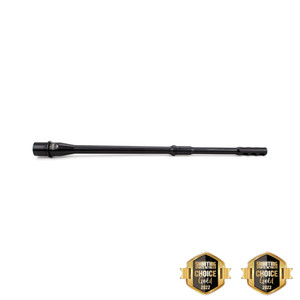
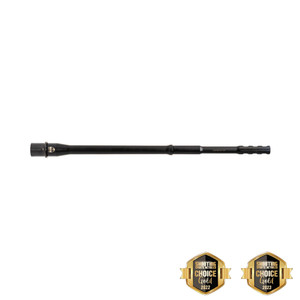
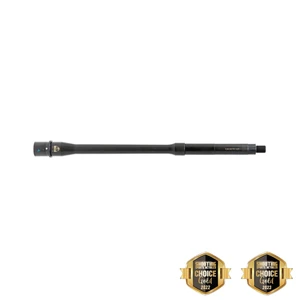
5.56 NATO, By the Numbers
The .223 Remington was developed by Remington with ArmaLite’s Eugene Stoner for the AR-15 and accepted by the U.S. Army in 1963; the 5.56x45 NATO version, with FN’s heavier SS109 bullet, was standardized by NATO in 1980. The two share a case, but the NATO chamber has a longer throat and the NATO round runs to a higher pressure standard, which is why Faxon cuts every Duty Series barrel with a 5.56 NATO chamber: it fires 5.56 and .223 Remington safely, and a .223 chamber does not return the favor.
The cartridge is a 55 to 77 gr .224 bullet at 2,700 to 3,200 fps, and what a barrel does with it is mostly length. Hornady’s published figures from a 20″ test barrel put a 55 gr FMJ at 3,240 fps; a 16″ gives up roughly 100 to 150 fps to that, a 14.5″ a little more, and by 10.5″ a 55 gr load is running around 2,600 fps, which is why the short barrels favor heavier bullets and why the 11.5″ has become the standard short 5.56: it is the shortest length that keeps a 55 gr bullet above its fragmentation threshold past 50 yards.
Twist decides which bullets stabilize. Faxon rifles every Duty Series 5.56 barrel at 1:8, which handles the 55 gr practice load, the 62 gr M855-weight load, and the 75 and 77 gr match and duty loads without over-spinning the light bullets the way a 1:7 can. Gas system length decides how the rifle cycles: carbine gas on a 10.5″ or 11.5″ is the proven short-barrel layout; mid-length on 14.5″ and 16″ is softer and cleaner; rifle-length on 18″ and 20″ is the smoothest of all.
Manufacturer-published factory data — 20″ test barrel where stated
| Load | Bullet | Muzzle velocity | Muzzle energy | Test barrel |
| Hornady Frontier 5.56 | 55 gr FMJ-BT (M193-type) | 3,240 fps | 1,282 ft-lb | 20″ |
| Hornady BLACK 5.56 | 62 gr FMJ | 3,060 fps | 1,289 ft-lb | 20″ |
| Hornady Superformance Match 5.56 | 75 gr BTHP | 2,910 fps | 1,410 ft-lb | 20″ |
| Federal Gold Medal .223 Rem | 77 gr Sierra MatchKing | 2,720 fps | 1,265 ft-lb | not stated |
Sources: Hornady and Federal product pages. Expect roughly 100–150 fps less from a 16″ barrel, about 250 fps less from 14.5″, and 500–600 fps less from 10.5″; these are estimates, not Faxon chronograph figures.
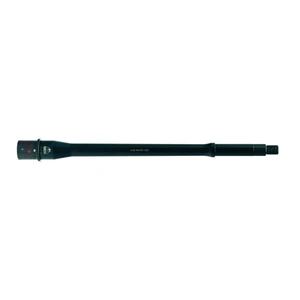
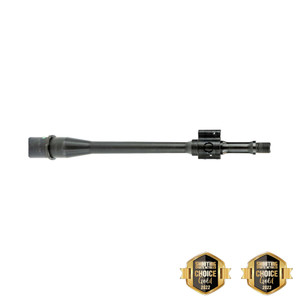
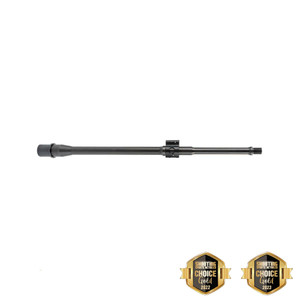
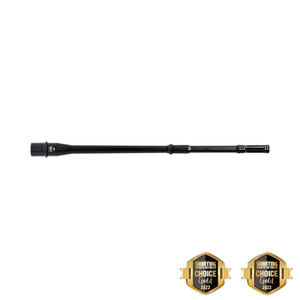
Duty Series 5.56 NATO / .223 Remington Barrels
All 1:8 twist, 4150 CMV, QPQ nitride inside and out, 1/2x28 muzzle. Weights are nominal; prices are MSRP.
What You Need to Build It
Standard 5.56 bolt carrier group, mil-spec upper, and barrel nut; standard AR-15 magazines. Pencil and Gunner barrels take a .625″ gas block (1.1″ journal on Pencil, 1.9″ on Gunner); SOCOM and HBAR take a .750″ block (1.9″ and 1.1″). The gas tube matches the system in the product name: pistol on the 7.5″, carbine on the 10.5″ and 11.5″ carbine, mid on 11.5″ mid through 16″, rifle on 18″ and 20″. Muzzle is 1/2x28 on every 5.56 barrel.
What Every Duty Series Barrel Shares
Duty Series is Faxon’s 4150 CMV line: the M4/M16 barrel alloy, button rifled, stress relieved, and salt-bath QPQ nitrided inside the bore and out, which hardens the surface while adding virtually nothing to it, roughly a tenth the width of a human hair, and leaves no plated layer to wear through. Every barrel is turned, crowned at 11°, chambered, 100% wet magnetic-particle inspected, and nitrided, then has its gas port drilled and reamed and its extension torqued to 150 ft-lb, pinned, and headspaced with a go/no-go gauge, and is laser-engraved with the Faxon shield, order number, and cartridge and twist, in Faxon’s Greater Cincinnati, Ohio plant. Faxon’s AR-15 and AR-10 barrels have been voted Favorite Aftermarket Barrel by Shooting Sports Retailer every year since 2022. All Duty Series barrels › All rifle barrels ›
Duty Series 5.56 NATO / .223 Remington FAQs
Can I shoot .223 Remington in a 5.56 NATO barrel?
Yes. Every Duty Series 5.56 barrel has a 5.56 NATO chamber, which is cut with the longer throat the NATO round needs and fires .223 Remington safely. The reverse is not true: 5.56 in a .223-chambered barrel raises pressure beyond what that chamber is rated for.
Which 5.56 length should I choose?
16″ is the shortest barrel that makes a rifle without extra paperwork and gives up only about 100–150 fps to a 20″. 14.5″ and 13.9″ are for a rifle that will have a device permanently attached to reach 16″. 10.5″ through 12.5″ are pistol and SBR lengths, where 11.5″ is the sweet spot for keeping a 55 gr bullet effective past 50 yards. 18″ and 20″ are for velocity and the softest gas system.
Is 1:8 twist right for 77 gr bullets? For 55 gr?
Yes to both. 1:8 stabilizes everything from 55 gr through 77 gr, including the 75 and 77 gr match and duty loads, and does not over-spin light varmint bullets the way 1:7 can. It is why Faxon uses 1:8 on every Duty Series 5.56 barrel.
Do I need an adjustable gas block on a 5.56 barrel?
Not for an unsuppressed rifle on factory ammunition: every barrel is ported to cycle a standard buffer. The adjustable block earns its place suppressed, and on the 11.5″ and 12.5″ mid-length barrels, which carry a large port for their short dwell and shoot noticeably softer with the gas metered.
Ballistics are manufacturer-published figures from the test barrels stated; velocity estimates for other lengths are approximations, not Faxon chronograph data. Dimensions are from Faxon engineering prints; weights are nominal. Prices are MSRP. Check your state’s hunting regulations before choosing a cartridge.