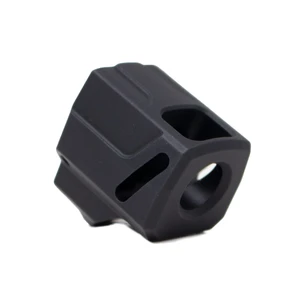
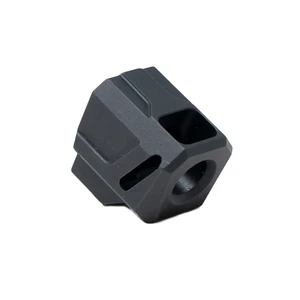
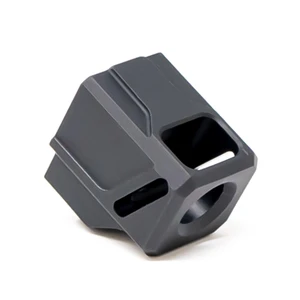
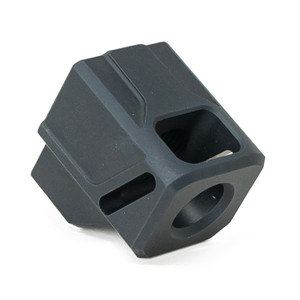
What Is a Pistol Compensator, and How Does EXOS® Work?
A pistol compensator is a muzzle device that threads onto a pistol barrel and redirects propellant gas as it leaves the bore. On a semi-automatic pistol the bore sits above your hand, so recoil rotates the muzzle upward — what shooters call muzzle flip or muzzle climb. A compensator uses the gas that would otherwise vent straight forward to push the muzzle back down, so the sights settle faster and follow-up shots come sooner.
EXOS® does this with a single expansion chamber and three ports angled at 45°. Straight-up ports vent gas only after it has already left the bore axis; the angled EXOS ports catch gas earlier and vector it up and forward, so more of the available energy goes into counteracting flip. A single chamber keeps the comp short (1.125″ installed length ahead of the slide) and light, which matters on a carry or duty pistol where a long, heavy comp changes how the slide cycles.
Every EXOS® model is cut for one specific host. Barrel outside diameter, thread shoulder position, and guide-rod clearance all differ between a Glock® 19, a P365, and a Shield Plus, so rather than one universal comp with a loose bore, each EXOS® is bored and profiled so it sits flush with the slide on a Faxon threaded barrel and clears the guide rod through the full slide stroke.
Tested: Muzzle Rise Reduction by Host
Faxon measured each EXOS® model in a Ransom rest, firing 115 gr 9mm and recording the muzzle’s peak upward rotation in degrees with the bare threaded barrel and with the comp installed. Where the same host was also run with leading aftermarket compensators under identical conditions, the EXOS® ranking is shown. Percentages are averages of multiple recorded shots; your results will vary with ammunition, recoil spring, and grip.
| Host Pistol |
EXOS® Model |
Muzzle Rise vs. Bare Muzzle |
Against Leading Aftermarket Comps |
| Glock® 19 Gen 3 | EXOS-513 | −28% | Lowest muzzle rise of all comps tested, and the most consistent shot-to-shot |
| SIG® P320 Full-Size | EXOS-515 | −22% | Lowest muzzle rise of all comps tested |
| Glock® 48 / 43X | EXOS-533 | −33% | Lowest muzzle rise of all comps tested |
| SIG® P365 XL | EXOS-525 | −27% | Lowest muzzle rise of all comps tested |
| M&P® Shield / Shield Plus | EXOS-524 | −29% | Top two of the comps tested |
| M&P® 9 Full-Size | EXOS-514 | −24% | Top two of the comps tested, within a degree of the leader |
| Glock® 43 | EXOS-523 | −27% | Bare-vs-comp only |
EXOS-543 (Gen 4) and EXOS-553 (Gen 5) use the same porting and internal design as EXOS-513; only the body profile changes to match each generation’s slide geometry. Across every host where a head-to-head was run, EXOS® posted the lowest muzzle rise on four of six pistols and finished in the top two on all six.
Which EXOS® Fits Your Pistol
All nine models are 9mm, 1/2x28, and $85. Match the model to your pistol and generation. “Also fits” hosts share thread and clearance dimensions closely enough that shooters run them successfully, but EXOS® was not engineered or tested on them — use on those pistols is at the owner’s discretion.
| Model |
Engineered For |
Also Fits (Owner’s Discretion) |
Part No. |
| EXOS-513 | Glock® 17 / 19 / 34 Gen 3, Faxon FX-19 | Other Gen 3-pattern 9mm frames | FF-P-A-COMP-DS-G-01 |
| EXOS-543 | Glock® 17 / 19 / 34 Gen 4 | — | FF-P-A-COMP-DS-G-02 |
| EXOS-553 | Glock® 17 / 19 / 34 Gen 5 | — | FF-P-A-COMP-DS-G-03 |
| EXOS-523 | Glock® 43 | — | FF-P-A-COMP-SS-G-01 |
| EXOS-533 | Glock® 43X / 48 | — | FF-P-A-COMP-SS-G-02 |
| EXOS-515 | SIG® P320 Full-Size | P320 Compact / Carry | FF-P-A-COMP-DS-S-01 |
| EXOS-525 | SIG® P365 / P365 XL | — | FF-P-A-COMP-SS-S-01 |
| EXOS-514 | S&W M&P® 9 1.0 Full-Size (4.25″) | M&P® 2.0 Compact 4″ and Full-Size 4.25″ | FF-P-A-COMP-DS-MP-01 |
| EXOS-524 | S&W M&P® Shield / Shield Plus | — | FF-P-A-COMP-SS-MP-01 |
Specifications
| Caliber | 9mm |
| Thread | 1/2x28 |
| Material | 6061 aluminum |
| Finish | Black anodized |
| Design | Single chamber, three ports angled 45° |
| Installed Length | 1.125″ ahead of the slide, all models. Some models carry rear “wings” that mate to the slide profile, so overall part length varies by host. |
| Retention | Thread locker on the muzzle threads, plus two 6-32 set screws |
| Fit | Flush with slide on Faxon barrels with ≤ 0.600″ protrusion |
| Made In | USA — machined in Greater Cincinnati, Ohio |
| Warranty | Faxon Lifetime Guarantee |
What’s in the Box
EXOS® compensator — fitted to your host model
Two 6-32 set screws — index the comp on the barrel so it cannot rotate or back off
Thread locker — for the barrel’s muzzle threads
1/16″ hex wrench — the only tool you need
Installation in Four Steps
1. Unload and field-strip. Clean the barrel threads and the comp bore.
2. Apply the included thread locker to the barrel’s muzzle threads, thread the comp on by hand until it seats, then back off just enough to point the ports straight up (12 o’clock).
3. Snug the two set screws with the 1/16″ wrench to index the comp. No thread locker on the set screws, and do not over-torque into an aluminum body.
4. Reassemble and cycle the slide by hand to confirm the comp clears the guide rod and the slide returns fully to battery.
Watch: EXOS® Overview and Installation
A short walkthrough of what EXOS® is, how it fits your barrel, and the install steps above.
Built as a pair
EXOS® + a Faxon Threaded Barrel
EXOS® will thread onto any quality 1/2x28 9mm barrel, but it is dimensioned around Faxon’s own threaded pistol barrels: the thread shoulder position and barrel protrusion are what let the comp sit flush with the slide with no gap and no overhang. Faxon pistol barrels come in two lines — Match Series in 416-R stainless and Duty Series in 4150 CMV — and both are offered threaded 1/2x28 for every host EXOS® supports.
Glock® Barrels › SIG® Barrels › M&P® Barrels ›
EXOS® Pistol Compensator FAQs
What does a pistol compensator actually do?
It redirects gas leaving the muzzle to push the barrel down, reducing muzzle flip so the sights return to target faster. It does not reduce the total recoil energy of the cartridge; it changes the direction the muzzle moves. In Faxon’s testing, EXOS® reduced measured muzzle rise by 21–33% depending on the host pistol.
How much muzzle rise does EXOS® remove?
Between 21% and 33% versus a bare threaded barrel on the same pistol, measured in a Ransom rest with 115 gr 9mm. The Glock® 48 and 43X saw the largest reduction (33%), the P320 Full-Size the smallest (22%), with most hosts in the high twenties. See the table above for each model.
Why are there separate models for Glock® Gen 3, Gen 4, and Gen 5?
Barrel and slide dimensions changed between generations. EXOS-513, EXOS-543, and EXOS-553 share the same porting and internal design; only the body profile changes so the comp sits flush with each generation’s slide and clears the guide rod. EXOS-513 also fits the Faxon FX-19, which is built on the Gen 3 pattern.
Will EXOS® work on a non-Faxon threaded barrel?
If the barrel is 1/2x28 and its protrusion past the slide is 0.600″ or less, yes. On barrels with more protrusion the comp will still function but will stand off the slide rather than sit flush. EXOS® was engineered around Faxon’s threaded pistol barrels, which is where you get the flush, factory look.
Do I need a different recoil spring?
Usually not with standard-pressure or +P defensive and range ammunition. A compensator bleeds off gas that would otherwise help drive the slide, so very light target loads can occasionally fail to lock the slide back on the last round. If that happens, step up to a standard 115–124 gr load first; a slightly lighter recoil spring is the next option for shooters who run light loads exclusively.
Will my holster still fit?
Installed, EXOS® adds 1.125″ ahead of the slide on every model. Open-bottom holsters generally work as-is; closed-toe holsters need to be cut for a compensator. Most holster makers offer a compensator option for the pistols EXOS® supports.
Can I use EXOS® with a suppressor-height sight or optic?
Yes. EXOS® is a single-chamber comp with a low profile above the bore, so it does not block standard-height sights or a slide-mounted optic. Ports vent upward, so expect some visible gas and debris in the sight picture on bright days, which is normal for any top-ported comp.
Where is EXOS® made?
Every EXOS® is machined from 6061 aluminum and black anodized in the USA by Faxon Firearms, a family-owned, federally licensed manufacturer in Greater Cincinnati, Ohio, and is covered by the Faxon Lifetime Guarantee.
Glock® is a registered trademark of Glock, Inc. SIG®, P320®, and P365® are registered trademarks of SIG SAUER, Inc. M&P® and Shield® are registered trademarks of Smith & Wesson. Faxon Firearms is not affiliated with or endorsed by any of these companies. Muzzle-rise figures are from Faxon internal Ransom-rest testing with 115 gr 9mm ammunition; results vary with ammunition, recoil spring, and host condition. Compensators are not restricted items under federal law; check state and local regulations. Always confirm function with your chosen ammunition before carrying.