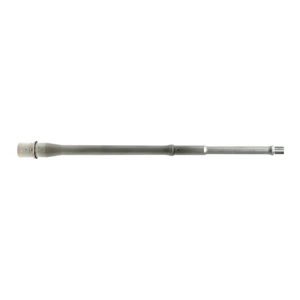
.223 Wylde, By the Numbers
.223 Wylde is not a cartridge; it is a chamber. Bill Wylde designed it to solve a problem competitors had with the AR-15: a 5.56 NATO chamber has a long, loose leade that keeps pressure safe with military ammunition but costs accuracy with .223 Remington match loads, while a true .223 Remington chamber shoots those loads well but runs 5.56 NATO at higher pressure than it was designed for. The Wylde chamber uses the 5.56 NATO body and freebore dimensions with the tighter .223 Remington leade angle, so it fires both cartridges safely and shoots .223 match ammunition to its potential. It has become the standard chamber for precision AR-15s, service rifle, and 3-gun for that reason.
Twist decides the bullet. A 1:8 twist stabilizes everything from 55 gr ball to the 77 gr match bullets and is the all-around choice, which is why the 16″ MATCH-X Gunner uses it. A 1:7 twist is what the 20″ Target uses because the long 80 and 90 gr bullets single-loaded at 600 yards need the extra spin; 1:8 is marginal with the 90s. Neither twist hurts light bullets at these velocities.
Barrel length is mostly velocity. Hornady publishes its .223 data from a 24″ test barrel; a 20″ barrel gives up roughly 50 to 75 fps to that and a 16″ roughly 150 to 200 fps. For a 77 gr match bullet that is the difference between a comfortable supersonic margin at 600 yards from the 20″ and a marginal one from the 16″, which is why the service-rifle barrel is 20 inches and the carbine is 16.
Hornady factory data — .223 Rem 73 gr ELD Match, 24″ test barrel
| Range | Velocity | Energy | Drop (200 yd zero) |
| Muzzle | 2,790 fps | 1,262 ft-lb | — |
| 100 yd | 2,563 | 1,065 | +1.9″ |
| 200 yd | 2,348 | 894 | 0 |
| 300 yd | 2,143 | 744 | −8.2″ |
| 400 yd | 1,949 | 616 | −24.0″ |
| 500 yd | 1,766 | 505 | −49.0″ |
Source: Hornady published ballistics for .223 Rem 73 gr ELD Match from a 24″ barrel. Expect roughly 50–75 fps less from the 20″ MATCH-X Target and 150–200 fps less from the 16″ Gunner. Both barrels are .223 Wylde chambers and shoot .223 Remington and 5.56 NATO.
What You Need to Build It
Both barrels use a standard 5.56 bolt carrier group and magazines and a standard barrel nut. The 16″ Gunner takes a .625″ gas block and a mid-length gas tube; the 20″ Target takes a .750″ gas block and a rifle-length tube. Both are headspaced with a go/no-go gauge before they ship.
What Every MATCH-X Barrel Shares
416-R stainless bar stock, drilled, reamed to 32 Ra, honed to 8 Ra before the rifling button goes through, 5R button rifled, stress relieved at 1150°F, contoured, chambered, then lapped back to a uniform 16 Ra from throat to crown. Bore and groove air-gauged at three points, honed finish read on a profilometer, borescoped, chamber verified on a CMM, magnetic-particle inspected, nickel-Teflon extension torqued to 150 ft-lb, pinned, and headspaced. Exterior left as bare stainless blasted with S110 media. Made in Greater Cincinnati, Ohio, backed by the Faxon Lifetime Guarantee. See the whole MATCH-X line and the process video ›
MATCH-X .223 Wylde FAQs
Can I shoot 5.56 NATO in a .223 Wylde chamber?
Yes. .223 Wylde uses 5.56 NATO body and freebore dimensions with a tighter .223 Remington leade, so it handles 5.56 pressure safely and shoots .223 match loads more accurately than a NATO chamber. Both .223 Remington and 5.56x45 are correct for these barrels.
1:7 or 1:8?
1:8 for an all-around rifle shooting 55 to 77 gr bullets; that is the 16″ Gunner. 1:7 if you will single-load 80 to 90 gr bullets for 600-yard work; that is the 20″ Target. Both shoot the common 55, 62, 69, and 77 gr loads well.
Which MATCH-X Wylde is right for me?
The 16″ Gunner (1.35 lb, mid-length gas) is the lightweight precision carbine. The 20″ Target (3.10 lb, rifle-length gas) is the service-rifle, High Power, and DMR barrel. Same bore finish, same chamber; the difference is weight, velocity, and the twist.
What gas block and tube do I need?
.625″ gas block and a mid-length tube for the 16″ Gunner; .750″ gas block and a rifle-length tube for the 20″ Target. Faxon's adjustable block in either size is recommended if you shoot suppressed or run a lightweight carrier.