
Posted by Faxon Firearms Staff on Sep 23rd 2026
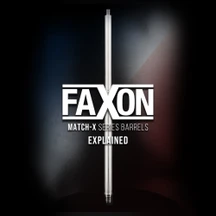
Faxon MATCH-X Series Barrels Explained: Honed, Lapped, Uncoated 416-R, and Which One to Buy
MATCH-X Series • Barrel Guide
Short version: the Faxon MATCH-X Series is our line of uncoated 416-R stainless AR-15 and AR-10 barrels built the way match barrels have always been built, just under one roof. The bore is honed to 8 Ra before rifling, 5R button rifled, stress relieved, and lapped back to a uniform 16 Ra after all machining. Every barrel is air-gauged, borescoped, CMM-checked at the chamber, magnetic-particle inspected, and shipped with its nickel-Teflon extension installed and headspaced. Bare stainless, no coating in the bore, no outsourced steps. Ten barrels, eight cartridges, $213 to $337, made in Greater Cincinnati, Ohio. Below: what each of those words means, how the barrel is made, the full lineup, and how to pick one.
What the MATCH-X Series Is
A MATCH-X is a Faxon AR barrel machined from 416-R stainless steel and left bare, the way precision barrels have traditionally been made: no coating in the bore or on the exterior. The exterior is blasted with S110 media for a matte, glare-free surface. Inside, the bore is finished by honing and lapping to a measured surface, which is the point of the series. It sits alongside our nitrided Match Series; the two are built for different shooters, and this article explains which one you are.
The name is literal. Every MATCH-X is built to the same process card regardless of cartridge or length: drilled, reamed, honed, button rifled with 5R rifling, stress relieved, contoured, chambered, lapped, inspected, and assembled in the same building. The series currently covers .223 Wylde, 300 Blackout, 6mm ARC, 22 ARC, and 6.5 Grendel on the AR-15 side, and .308 Winchester, 6.5 Creedmoor, and 8.6 Blackout on the AR-10 side.
Where the MATCH-X Fits Next to the Match Series
Most Faxon barrels are nitrided, and we would not build them any other way. Nitride hardens the surface of the steel, extends bore life, resists corrosion, and gives a barrel that can be run hard, run wet, and cleaned when there is time. Our Match Series is 416-R stainless with the same 5R rifling and the same in-house machining as the MATCH-X, finished in nitride, and it is the barrel we recommend for the majority of builds, from duty and defensive rifles to competition guns that see thousands of rounds a season.
The MATCH-X is for the precision purist. It follows the formula custom and benchrest barrel makers have used for decades: stainless steel, a bore honed before rifling and lapped after, and nothing applied over it. What you get is an as-machined barrel-to-bullet interaction. The lands and grooves the button formed, the surface the lap finished, and the numbers the profilometer, air gauge, and borescope recorded are exactly what the bullet rides on. Nothing sits between the steel and the jacket. For a shooter who reads bore finish the way a reloader reads a chronograph, that is the appeal: the bore is known, measured, and uniform from throat to crown, and every one of those measurements describes the barrel in the box.
8 Ra Before Rifling, 16 Ra After: What the Numbers Mean
Ra is roughness average, the average height of the peaks and valleys on a surface, measured in microinches. Lower is smoother. A reamed barrel blank comes off the reamer at roughly 32 Ra. Before rifling, we hone the MATCH-X bore to 8 Ra and check it on a profilometer. That is smoother than most finished barrels, and it is deliberate: the rifling button is going to form the lands and grooves against this surface, and the cleaner the surface it starts from, the cleaner the rifling it leaves.
Then the finish gets rougher, on purpose and unavoidably. Button rifling is cold forming. A carbide button is pulled through the bore under tons of force, displacing steel to raise the lands and cut the grooves, and displaced metal is never as smooth as honed metal. Stress relief follows, at 1150°F for at least four hours, to relax the stresses the button put into the steel so the barrel does not walk as it heats. Then the barrel is contoured on the outside and the chamber is reamed. Each of those touches the bore again.
The last bore operation is the lap. A machine pulls a charged brush lap through the rifled, chambered bore and takes the surface to a uniform 16 Ra from throat to crown. Sixteen, not eight: the finished MATCH-X bore is 16 Ra. That is not a compromise. It is the finish precision barrel makers have converged on for lapped bores, and there is a reason a bore can be too smooth. Copper fouling is adhesion: under the pressure and heat of firing, jacket material cold-welds to the steel wherever the two make intimate contact. Take a bore toward a mirror finish and you increase the real contact area between jacket and steel, and you take away the fine, rifling-parallel texture that lets the jacket shear cleanly instead of sticking. Precision barrel makers have said as much for years: lapping finer past this point does not reduce fouling, it increases it. A uniform 16 Ra with the lay running with the rifling is smooth enough that nothing catches, and textured enough that the jacket rides the lands rather than bonding to them, so fouling stays light and lifts with a few patches.
If you want a reference for 16 Ra outside the barrel world: a ground automotive crankshaft journal is specified around 15 Ra, and a hydraulic valve spool is in the same class. The #4 brushed stainless on an appliance panel is 25 to 40 Ra. A MATCH-X bore is smoother than the front of your refrigerator and in the same class as a bearing surface.
How a MATCH-X Barrel Is Made
This is the routing every MATCH-X follows, in order. It is the same card for a 7.5″ 300 Blackout and a 24″ 6.5 Creedmoor.
| Step | What happens |
| 1. Drill and ream | 416-R stainless bar is gun-drilled and reamed to a straight, round bore at roughly 32 Ra. |
| 2. Hone | The bore is honed to 8 Ra and verified on a profilometer before any rifling happens. |
| 3. Rifle | A 5R carbide button is pulled through to form five lands and grooves with sloped land edges. Twist rate is set here, from 1:10 in .308 to 1:3 in 8.6 Blackout. |
| 4. Stress relieve | 1150°F for a minimum of four hours to relax the stresses cold forming put into the steel. |
| 5. Contour and chamber | The exterior profile is turned, the gas journal is finished and held within .005″ of the bore, the muzzle is threaded and given a recessed target crown, and the chamber is reamed. |
| 6. Lap | A brush lap takes the finished bore to a uniform 16 Ra from throat to crown. |
| 7. Inspect | Bore and groove diameters are air-gauged at three points, the chamber is verified on a CMM, and every barrel is borescoped and magnetic-particle inspected. |
| 8. Assemble and finish | The nickel-Teflon barrel extension is torqued to 150 ft-lb, pinned, and the barrel is headspaced with a go/no-go gauge. The exterior is blasted with S110 media with the bore plugged and the extension, threads, and gas port masked. Then the barrel is engraved. |
One detail is worth pulling out: the extension. Most AR barrels ship with a plain steel M4 extension; the MATCH-X uses one plated in nickel-Teflon, which is slicker for the bolt lugs and does not need oil to stay that way.
See It Made
A minute and a half that walks through the whole routing above, from bar stock to the lap, over hero shots of the finished barrel and cutaways to the checks it passes in Greater Cincinnati: the profilometer on the honed bore, the borescope, and the shaft gauge that measures every barrel before it ships.
What Every MATCH-X Barrel Shares
| Material | 416-R stainless steel, uncoated |
| Bore finish | Honed to 8 Ra before rifling; lapped to 16 Ra after all machining |
| Rifling | 5R, button rifled |
| Stress relief | 1150°F, 4 hours minimum |
| Exterior | Blasted with S110 media; extension, threads, and gas port masked |
| Extension | M4 (AR-15) or DPMS-pattern (AR-10), nickel-Teflon, torqued to 150 ft-lb, pinned |
| Headspace | 100%, go/no-go gauge, with the extension installed |
| Gas journal | Held within .005″ of bore |
| Crown | Recessed target crown |
| Inspection | Air-gauged bore and groove at three points, profilometer, borescope, CMM chamber check, magnetic particle inspection |
| Origin | Made in Greater Cincinnati, Ohio, USA |
| Warranty | Faxon Lifetime Guarantee |
The MATCH-X Lineup
Ten barrels as of this writing. Gunner is Faxon’s hybrid profile, thin ahead of the gas block for weight; Target is the heavy profile for stiffness and heat capacity. Every row links to the product page.
| Platform | Cartridge | Length / Profile | Gas | Twist | Journal | Muzzle | Weight | MSRP |
| AR-15 | .223 Wylde | 16″ Gunner | Mid | 1:8 | .625″ | 1/2x28 | 1.35 lb | $267 |
| AR-15 | .223 Wylde | 20″ Target | Rifle | 1:7 | .750″ | 1/2x28 | 3.10 lb | $272 |
| AR-15 | 300 Blackout | 7.5″ Gunner | Pistol | 1:5 | .750″ | 5/8x24 | 0.89 lb | $213 |
| AR-15 | 6mm ARC | 20″ Target | Rifle | 1:7.5 | .750″ | 5/8x24 | 3.13 lb | $279 |
| AR-15 | 22 ARC | 22″ Target | Rifle | 1:7 | .750″ | 1/2x28 | 3.43 lb | $271 |
| AR-15 | 6.5 Grendel | 18″ Target | Mid | 1:8 | .750″ | 5/8x24 | 2.64 lb | $271 |
| AR-10 | .308 Win | 20″ Target | Rifle | 1:10 | .750″ | 5/8x24 | 4.00 lb | $322 |
| AR-10 | 6.5 Creedmoor | 24″ Target | Rifle | 1:8 | .750″ | 5/8x24 | 4.53 lb | $337 |
| AR-10 | 8.6 Blackout | 12″ Gunner | Pistol | 1:3 | .875″ | M18x1.5 taper | 2.2 lb | $309 |
| AR-10 | 8.6 Blackout | 16″ Gunner | Carbine | 1:3 | .875″ | M18x1.5 taper | 2.33 lb | $315 |
Prices are MSRP at publication. Sold-out barrels stay in the table; they come back around as runs complete. The full series lives at Rifle Barrels › MATCH-X Series, split into subcategories by cartridge.
Which MATCH-X Barrel Is Right for You
A light, accurate general-purpose 5.56 upper
The 16″ Gunner .223 Wylde. At 1.35 lb it is the lightest rifle-length barrel in the series, the mid-length gas system is soft-shooting on 16″, and the .223 Wylde chamber shoots 5.56 NATO and .223 Remington safely with match-chamber accuracy. It takes a .625″ gas block.
Precision from an AR-15
Four Target-profile barrels, one per cartridge. The 20″ Target .223 Wylde with a 1:7 twist for 69 to 80 gr match bullets; the 20″ Target 6mm ARC at 1:7.5, the cartridge Faxon was among the first to barrel, which pushes a 108 gr ELD Match at 2,750 fps from a 24″ test barrel per Hornady; the 22″ Target 22 ARC at 1:7 for 75 to 90 gr .224 bullets; and the 18″ Target 6.5 Grendel at 1:8 with a Type II chamber. The Grendel, 22 ARC, and 6mm ARC all run on a 6.5 Grendel-pattern bolt; the Wylde runs a standard 5.56 bolt.
Suppressed and subsonic
The 7.5″ Gunner 300 Blackout at 1:5 is built for heavy subsonics through a can, at 0.89 lb. If you want the same barrel in nitride, its sister 15B35P7NGQ-5R-NP3 has been Faxon’s best-selling single rifle barrel since 2025. On the large frame, the 12″ and 16″ Gunner 8.6 Blackout carry the original 1:3 twist the cartridge was designed around and the M18x1.5 taper muzzle, with a taper adapter in the box. 8.6 Blackout is now SAAMI-standardized at 1:6; Faxon makes both, and these 1:3 barrels want ammunition loaded for a 1:3 twist.
Large-frame precision
The 20″ Target .308 Winchester at 1:10 for 168 to 175 gr, and the 24″ Target 6.5 Creedmoor at 1:8 for 140 gr and up. Both use a DPMS-pattern nickel-Teflon extension and a standard .308 bolt.
Reading the Muzzle: Faxon’s Caliber Marks
Because uncoated barrels of different cartridges can look alike on a bench, MATCH-X barrels carry Faxon’s caliber identification marks near the muzzle. Three rings means 300 Blackout, so a Blackout barrel is never mistaken for 5.56. On the AR-10 side, two rings means 6.5 Creedmoor and no rings means .308 Winchester. The 8.6 Blackout barrels carry no rings; their tapered muzzle shoulder is the identifier, and nothing else in the lineup has one.
Living With an Uncoated Stainless Barrel
The exterior is bare 416-R with an S110 media-blasted matte surface. It is corrosion-resistant, not corrosion-proof. After a wet day or a lot of bare-hand handling, wipe it and put a light film of oil on it; the blasted surface holds oil well. Under a free-float handguard it needs about as much attention as the rest of your rifle. In the bore, treat it like any match barrel: use a bore guide, a good solvent, and bronze or nylon brushes only. A 16 Ra lapped bore fouls less than a rougher one and usually cleans in a few patches.
MATCH-X Series FAQs
What does “honed and lapped” mean on a MATCH-X barrel?
The bore is honed from a reamed finish of roughly 32 Ra down to 8 Ra before the rifling button goes through, so the lands and grooves are formed against the cleanest possible surface. After rifling, stress relief, contouring, and chambering, the bore is brush-lapped back to a uniform 16 Ra from throat to crown. The finished bore is 16 Ra, not 8; the 8 Ra number is the surface the rifling was formed on.
How is the MATCH-X different from Faxon’s nitrided Match Series?
Same 416-R stainless, same 5R rifling, same in-house machining and inspection. The Match Series is finished in nitride, which hardens the surface, extends bore life, and resists corrosion; it is the barrel we recommend for most builds. The MATCH-X is left as machined, with the bore honed to 8 Ra before rifling and lapped to a measured 16 Ra after, for the precision purist who wants nothing between the bullet and the steel but the surface the lap left.
Is 16 Ra smooth?
Yes. 16 Ra is the class of finish found on a ground automotive crankshaft journal or a hydraulic valve spool, and it is smoother than #4 brushed stainless appliance panels, which run about 25 to 40 Ra. It is also the finish precision barrel makers have converged on for lapped bores. Copper fouling is adhesion, jacket material cold-welding to steel where the two make intimate contact; a mirror finish increases that contact area and fouls more, while a uniform 16 Ra with the lay parallel to the rifling lets the jacket shear cleanly and keeps fouling light.
Why does the bore finish go from 8 Ra to 16 Ra?
Button rifling is cold forming: the carbide button displaces steel to raise the lands and cut the grooves, which roughens the surface. Stress relief at 1150°F for at least four hours, contouring, and chambering all touch the bore again. The lap is the final operation, and it evens everything back to one number. Starting at 8 Ra means the button works cleaner metal, and 16 Ra is the intended finished spec.
What is 5R rifling?
A five-groove pattern with sloped land edges and no land directly opposite another. Compared with conventional square-cut six-groove rifling, 5R deforms the bullet jacket less, fouls less, and cleans faster. Every MATCH-X barrel is 5R.
Does the MATCH-X come with a gas block or gas tube?
No. Every MATCH-X ships with its nickel-Teflon barrel extension installed, torqued to 150 ft-lb, pinned, and headspaced with a go/no-go gauge. Gas block, gas tube, and muzzle device are sold separately. Journal sizes are .625″ on the 16″ Gunner .223 Wylde, .875″ on the 8.6 Blackout barrels, and .750″ on everything else.
How do I care for an uncoated stainless barrel?
Wipe it down and put a light film of oil on the exterior after wet-weather use or handling with bare hands. 416-R is corrosion-resistant but not corrosion-proof; the S110-blasted matte surface holds oil well. Clean the bore as you would any match barrel: a bore guide, quality solvent, and no stainless brushes in the bore.
Which MATCH-X barrel should I buy?
For a light, do-everything 5.56 upper, the 16″ Gunner .223 Wylde. For precision from an AR-15, the 20″ Target .223 Wylde, 6mm ARC, 22 ARC, or 6.5 Grendel depending on the cartridge you load or buy. For suppressed subsonics, the 7.5″ 300 Blackout or the 12″ and 16″ 8.6 Blackout. For large-frame precision, the 20″ .308 or 24″ 6.5 Creedmoor.
Honed. Rifled. Lapped. Made here.
Ten barrels, eight cartridges, $213–$337. Extension installed and headspaced. Faxon Lifetime Guarantee.
Surface finish values are Faxon process specifications measured by profilometer; crankshaft and stainless-sheet finish comparisons are published industry figures. Ballistic figures are Hornady-published from the test barrel lengths stated. Prices are MSRP at publication and subject to change. Gas block, gas tube, and muzzle device sold separately. 8.6 Blackout 1:3 barrels require ammunition loaded for a 1:3 twist.