
Posted by Faxon Firearms Staff on Oct 2nd 2026
Faxon Duty Series Barrels Explained: 4150 CMV, Nitride Inside and Out, and Which One to Buy
Duty Series • Barrel Guide
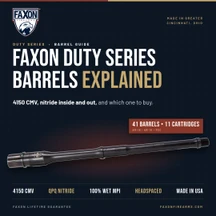
Short version: the Faxon Duty Series is our line of 4150 CMV AR-15, AR-10, and blowback PCC barrels: the M4 and M16 barrel alloy, button rifled, stress relieved, and salt-bath QPQ nitrided inside the bore and out, shipped with the extension torqued, pinned, and headspaced. Every barrel is air-gauged, 100% wet magnetic-particle inspected, and finished with an 11° target crown in Greater Cincinnati, Ohio. Forty-one barrels across eleven cartridges, in Pencil, Gunner, SOCOM, HBAR, Big Bore, and Light Tapered profiles, $125 to $244, covered by the Faxon Lifetime Guarantee. It is the barrel we build for the rifle that gets carried, run hot, and cleaned when there is time. Below: what each of those words means, how the barrel is made, every profile and cartridge, and how to pick one.

What the Duty Series Is
Faxon makes rifle barrels from two steels. 416-R stainless goes into the Match Series, the MATCH-X Series, and our bolt-action barrels. 4150 CMV goes into the Duty Series, and the name tells you what the barrel is for. A Duty Series barrel is built to the specification the military wrote for a service rifle barrel, steel and finish included, and then built the way Faxon builds everything: drilled, reamed, rifled, contoured, chambered, nitrided, inspected, and headspaced under one roof in Greater Cincinnati.
Every Duty Series barrel, whatever the cartridge, follows the same process card. The bore is gun-drilled and pull-reamed, air-gauged, button rifled, and air-gauged again. The blank is stress relieved and its outside qualified true to the bore so every later cut references the same axis. The profile is turned, the muzzle threaded and crowned, and the chamber cut to a go gauge. Every barrel is then 100% wet magnetic-particle inspected, and right after that the machined barrel goes into the nitride salt bath. After nitride, the gas port is drilled and reamed to the size set for that length and gas system, the extension goes on at 150 ft-lb and gets pinned, and the assembly is headspaced. Last, the barrel is laser-engraved with the Faxon shield, its order number, and its cartridge and twist. That is a Duty Series barrel from a 7.5″ 5.56 pistol barrel to a 20″ .308.
4150 CMV: Why the M4 Steel
Chrome-moly-vanadium steel, 4150 grade, is what the U.S. military specification for the M4 and M16 barrel calls for, and the reason is in the numbers. The 41xx family is chromium-molybdenum steel; the last two digits are the carbon content, so 4140 carries about 0.40% carbon and 4150 about 0.50%. That extra carbon, with the vanadium the CMV designation adds, raises the steel’s strength and its resistance to wear at temperature. A barrel throat during a fast string is one of the hottest places in a rifle, and the throat is where a barrel wears out first. 4150 CMV holds it longer.
4150 CMV by the numbers
4140 and 4150 are the same chromium-molybdenum recipe with one difference: carbon. Here are the published composition ranges for each grade.
| Element | AISI 4140 | AISI 4150 | What it does in a barrel |
| Carbon | 0.38–0.43% | 0.48–0.53% | The main hardening element: more carbon means higher attainable strength and wear resistance after heat treatment |
| Chromium | 0.80–1.10% | 0.80–1.10% | Hardenability, plus some resistance to oxidation and corrosion |
| Molybdenum | 0.15–0.25% | 0.15–0.25% | Hardenability and strength at temperature |
| Manganese | 0.75–1.00% | 0.75–1.00% | Hardenability and strength |
| Silicon | 0.15–0.30% | 0.15–0.30% | Deoxidizer; adds strength |
| Vanadium | — | Added in 4150 CMV | Fine grain, temper resistance, stable carbides and nitrides (see below) |
Composition: AZoM, AISI 4140 and AZoM, AISI 4150. Ranges are the AISI/SAE limits; phosphorus and sulfur limits omitted.
The “CMV” in 4150 CMV is chrome-moly-vanadium: 4150 with a vanadium addition, the barrel-quality grade that steel suppliers sell against MIL-B-11595E, the military specification for steel bar and blanks for small-arms barrels (supplier description). Vanadium earns its place in a barrel three ways: it keeps the grain fine and raises the temperature at which grain starts to coarsen; it resists softening when the steel is reheated, and can even produce secondary hardening; and it forms very stable carbides and nitrides that add strength (IspatGuru, Vanadium in Steels). Those are exactly the properties that matter in a throat that is heated and cooled thousands of times.
What the steel delivers depends on its heat treatment as much as its chemistry. Published figures for 4150 run from about 96,000 psi tensile strength annealed to roughly 190,000 psi quenched and tempered (MakeItFrom, SAE 4150), which is why barrel steel is bought to a specification and certified by the mill rather than by grade name alone.
4140 is honest barrel steel, and plenty of good barrels are made from it. But a barrel that will be shot hot, that will be run through a class or a match or a long day of doubles, is the barrel the specification was written for, and it says 4150. Faxon buys it as certified bar stock and machines it in-house from the first drill to the last engraving pass, so there is no outsourced step between the mill certificate and the finished barrel.
Nitride Inside and Out: What It Does, and Where Chrome Still Fits
Every Duty Series barrel is salt-bath QPQ nitrided, bore and exterior. Nitride is not a coating. It is a diffusion treatment: the barrel sits in a molten salt bath and nitrogen and carbon diffuse into the surface of the steel, where they form a hard compound layer and a hardened diffusion zone beneath it. Nothing is plated on top of the bore. It adds virtually nothing to the surface: the steel grows by roughly half the compound layer’s thickness, a few ten-thousandths of an inch (TS Tech Nickel). To picture it: .0002–.0004″ is 5 to 10 microns, roughly a tenth the width of a typical human hair, which runs 60 to 80 microns (The Physics Factbook), or about the diameter of a single red blood cell, 6 to 8 microns (overview). There is no plated layer to wear through, chip, or hide a tool mark under.
That is the difference from chrome lining, the finish the military specification has long called for. Chrome lining is a hard plating laid onto the bore after rifling, and it still has its place. It was developed for machine guns, and under the extreme, sustained heat of belt-fed and full-auto fire, thousands of rounds with the barrel glowing, a chrome-lined bore resists throat erosion better than any other common finish. That is why machine-gun barrels are chrome-lined and why some military and agency contracts still require it. If that is your use, chrome is the right answer.
For the vast majority of shooters, nitride does what they need and more. A semi-automatic rifle, even one run hard through a carbine class, a match, or a long day in the field, never sees machine-gun heat, and at everything short of that, nitride hardens the bore, resists corrosion, and protects the barrel inside and out. Nothing is plated on, so there is nothing to chip or wear through, and the exterior gets the same treatment, which chrome lining never covered. A Duty Series barrel comes out of the bath black, harder at the surface than the steel beneath, and needs little to no break-in.
Salt-bath QPQ nitride by the numbers
Salt-bath nitride is the common name for liquid ferritic nitrocarburizing, sold under trade names including Tufftride, Tenifer, and Melonite, and covered by the aerospace specification SAE AMS 2753. QPQ, for quench-polish-quench, is the full version of the process: the part is nitrocarburized, quenched in an oxidizing salt bath, polished, and oxidized again, which leaves the black oxide surface you see on a Duty Series barrel (Durferrit TUFFTRIDE®/QPQ® technical brochure).
| Property | Typical value | Source |
| Process temperature | About 580°C (1,075°F) | Durferrit, HEF |
| Why it barely distorts | The steel stays in its ferritic phase, so there is no phase transformation as there is in hardening | Ferritic nitrocarburizing overview |
| Compound (white) layer | 10–20 µm (about .0004–.0008″) on 42CrMo4, the European equivalent of 4140 | Durferrit |
| Diffusion zone | About 0.3–0.4 mm (.012–.016″) after 120 minutes on 42CrMo4 | Durferrit |
| Surface hardness | 600–1,200 HV depending on the steel; about 650 HV1 (roughly 58 HRC) on 42CrMo4 | HEF, Durferrit |
| Oxide layer | 2–3 µm of black iron oxide from the post-oxidation step | HEF, Melonite® QPQ |
| Neutral salt spray | No corrosion visible after 500 hours (DIN EN ISO 9227 NSS, QPQ-treated piston rods) | Durferrit |
| Acetic-acid salt spray vs. hard chrome | Hard-chrome-plated rods failed at 21 hours; QPQ rods averaged 114 hours (range 92–159) | Durferrit |
The corrosion tests are the process developer’s own, run on industrial piston rods rather than barrels; results vary with steel grade, part geometry, and process control. The HV-to-HRC conversion is approximate.
Put those numbers next to a barrel and the case for nitride is plain. At about 1,075°F the steel does not go through a phase change, so a stress-relieved, straight barrel comes out of the bath straight. The treated surface is far harder than the 4150 underneath and runs continuously from the lands into the grooves and across the throat, and the black oxide on top adds the corrosion resistance that lets a Duty Series barrel live in a truck or a duck blind.
How a Duty Series Barrel Is Made
The routing below is the same for every Duty Series barrel; only the numbers change with the cartridge.
| Step | What happens |
| Drill and pull-ream | 4150 CMV bar is gun-drilled, then pull-reamed from the chamber end to the bore diameter for the cartridge, held to ±.001″ and checked on a profilometer for finish. |
| Button rifle | A carbide button is pulled through from the chamber end to form the grooves at the cartridge’s twist: 1:8 on 5.56, 300 Blackout, and 7.62x39; 1:10 on .308 and 9mm; 1:16 on 350 Legend, 400 Legend, .450 Bushmaster, and 10mm; 1:14 on .458 SOCOM; 1:3 on 8.6 Blackout. Bore and groove are air-gauged. |
| Stress relieve and qualify | The rifled blank is stress relieved so machining and heat do not move the bore, then the outside is qualified true to the bore. |
| Turn the profile | Chamber journal, profile, gas journal and shoulder, and muzzle shoulder are turned true to the bore. The muzzle is threaded, gauged, and crowned at 11°. |
| Chamber | The chamber is cut to a go gauge and checked on every barrel, with chamber surfaces held to a fine finish. |
| Magnetic-particle inspect | 100% wet magnetic-particle inspection for surface and near-surface flaws, right before nitride. |
| Nitride | The machined barrel is salt-bath QPQ nitrided inside the bore and out, hardening the surface with no plated layer. |
| Port, extension, headspace | After nitride, the gas port is drilled and reamed, not just drilled, to the size set for that length and gas system; the extension is torqued to 150 ft-lb and pinned; and the assembly is headspaced with a go/no-go gauge. Blowback barrels get their indexing pin pressed in instead. |
| Engrave | Laser engraving of the Faxon shield, order number, and cartridge and twist. |
Two of those steps deserve a word. Wet magnetic-particle inspection is the more sensitive of the two MPI methods, and every Duty Series barrel gets it, not a sample. And the gas port is reamed to a size Faxon sets for each barrel individually: a shorter barrel or a shorter gas system gets a smaller port for its higher pressure, a longer one a larger port, so that every barrel cycles factory ammunition on a standard buffer out of the box.
The Six Profiles
Profile is the shape of the steel from the chamber to the muzzle, and in the same cartridge and length it is the main thing that separates one Duty Series barrel from another. Every profile shoots the same ammunition to the same velocity. What changes is weight, where the weight sits, and how many rounds it takes to heat the barrel up.
Pencil

The lightest barrel Faxon makes. A .625″ gas journal, 1.1″ long, on a thin, straight forward section; 1.15 lb at 14.5″ and 1.20 lb at 16″ in 5.56, and 1.83 lb for a 16″ .308. It is the barrel for a rifle that is carried far more than it is fired in long strings: a truck gun, a hunting carbine, a lightweight build where every ounce on the front end shows up in how the rifle points. It heats faster than the heavier profiles and it does not pretend otherwise. 16″ Pencil 5.56 ›
Gunner
Faxon’s signature profile and its most popular barrel. The Gunner runs a Government-taper section behind a .625″ × 1.9″ gas journal, then a light forward section to the muzzle, so the steel is where the heat is, behind the gas block, and the balance point sits at the magazine well. 1.37 lb at 16″ in 5.56. On 300 Blackout, 7.62x39, and 350 Legend the journal is .750″; on .308 it becomes the AR-10 Gunner (formerly Big Gunner), which put a 1.91 lb .308 barrel in a platform where three pounds had been normal. If you do not know which profile you want, this is the one. 16″ Gunner 5.56 ›
SOCOM

The heavy-duty M4 profile: a full .750″ × 1.9″ gas journal and the most steel of any 5.56 profile ahead of the chamber. 1.73 lb at 16″, 1.50 lb at 14.5″, 1.10 lb at 10.5″. This is the barrel for a rifle that will run suppressed, hot, and often, where heat capacity matters more than four ounces. The 10.5″ SOCOM on carbine gas is the standard short 5.56 for exactly that reason. 16″ SOCOM 5.56 ›
HBAR

The classic heavy-barrel rifle profile: a straight .800″ body behind a .750″ × 1.1″ gas journal and a straight .730″ forward section, 2.06 lb at 16″. It is the stiffest 5.56 barrel Faxon makes, for a rifle that is shot from a bench or a bipod and lives on a rack, and it is the one for the shooter who wants the barrel to settle down and stay settled through a long session. 16″ HBAR 5.56 ›
Gunner Big Bore

The Gunner idea scaled for the big straight-wall cases: a straight .875″ body, an .875″ × 1.9″ gas journal, and 11/16x24 muzzle threads on Faxon’s Big Bore M4 extension, for .450 Bushmaster, .458 SOCOM, and 400 Legend. The .450 and .458 barrels require Faxon’s Big Bore upper receiver, which opens the feed ramps and ejection port for the fat case, and it is a recommended option for 350 Legend. 8.6 Blackout uses the same .875″ journal on the AR-10 Gunner contour.
Light Tapered (PCC)

Faxon’s contour for blowback 9mm and 10mm: a 1.000″ receiver journal with an indexing pin, a .980″ collar, a short 15° taper, and a straight .750″ body to the muzzle. A blowback barrel carries no gas block, so there is nothing to step down to, and any free-float handguard fits. The feed ramp is machined into the barrel for Glock®-pattern magazines. 0.81 lb at 8.5″ and 1.34 lb at 16″ in 9mm; 1.08 and 1.59 lb in 10mm.
Gas Systems, Ports, and Journals
The gas system length in a Duty Series barrel’s name (pistol, carbine, mid, rifle) is the distance from the chamber to the gas port, and it decides how the rifle cycles. A longer gas system sees lower pressure at the port and cycles more softly; a shorter one sees higher pressure and is the proven layout for a short barrel. Faxon matches the system to the length: pistol gas on 7.5″ and the 8.6 and 300 Blackout pistols, carbine gas on 10.5″ and the 11.5″ carbine, mid-length from 11.5″ through 16″, rifle-length on 18″ and 20″. Each port is then reamed to the size that cycles a standard buffer for that exact combination.
The gas block journal is the machined section the block clamps to, and Faxon cuts it behind a shoulder so a low-profile block seats in the same place every time. Diameter follows the profile: .625″ on 5.56 Pencil and Gunner, .750″ on SOCOM, HBAR, 300 Blackout, 7.62x39, 350 Legend, and .308, .875″ on the big bores and 8.6 Blackout. Length is 1.9″ on Gunner, SOCOM, Big Bore, and AR-10 barrels and 1.1″ on Pencil and HBAR; any standard low-profile block fits either. Faxon’s adjustable gas blocks in all three diameters meter the port with no screw in the gas path, and they are the right pairing for any barrel that will run suppressed.
Every Cartridge in the Line
Forty-one barrels, eleven cartridges. Each cartridge below links to its own page with the ballistics, the bolt and magazine it needs, and every barrel Faxon makes for it.
| Cartridge | Barrels | Lengths | Profiles | Twist | Bolt / upper |
| 5.56 NATO / .223 | 16 | 7.5″–20″ | Pencil, Gunner, SOCOM, HBAR | 1:8 | Standard 5.56 |
| 300 Blackout | 3 | 7.5″, 10.5″, 16″ | Gunner | 1:8 | Standard 5.56 |
| 7.62x39 | 2 | 10.5″, 16″ | Gunner | 1:8 | 7.62x39 bolt |
| 350 Legend | 2 | 16″, 20″ | Gunner | 1:16 | Standard 5.56; Big Bore upper recommended |
| 400 Legend | 1 | 16″ | Gunner Big Bore | 1:16 | 6.8 SPC / .224 Valkyrie bolt |
| .450 Bushmaster / .458 SOCOM | 3 | 10.5″, 16″ | Gunner Big Bore | 1:16 / 1:14 | .458/.450 bolt; Big Bore upper required |
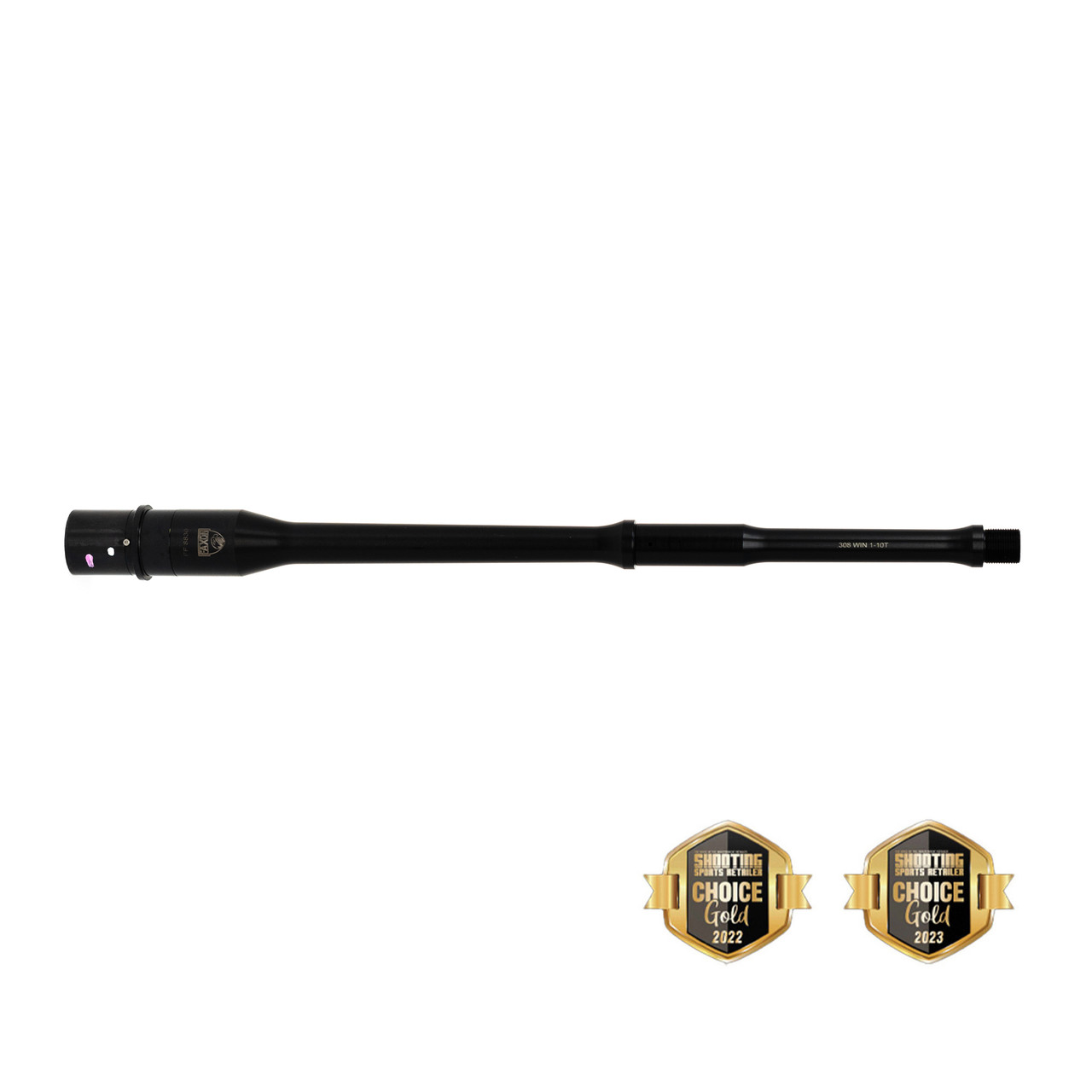
| .308 Winchester | 6 | 13.9″–20″ | AR-10 Gunner, Pencil | 1:10 | DPMS-pattern AR-10 |
| 8.6 Blackout | 3 | 8″, 12″, 16″ | AR-10 Gunner | 1:3 | DPMS-pattern AR-10 |
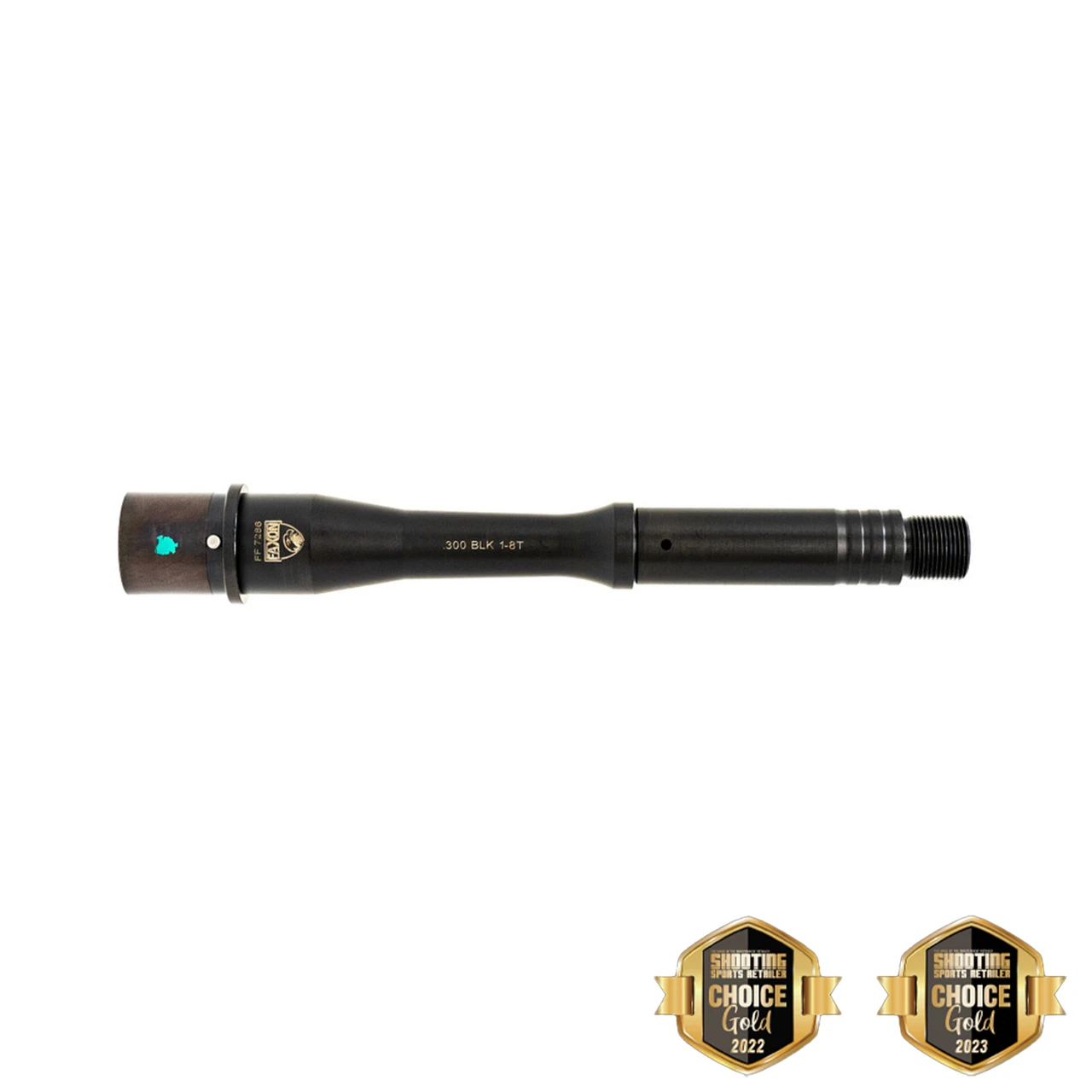
| 9mm | 3 | 8.5″, 10.5″, 16″ | Light Tapered | 1:10 | 9mm blowback BCG, Glock lower |
| 10mm Auto | 2 | 10.5″, 16″ | Light Tapered | 1:16 | 10mm blowback BCG, Glock 20 lower |
Two cartridges deserve a note. 8.6 Blackout was designed around a 1:3 twist, and Faxon was the first to button-rifle one for it at production scale; the Duty Series 8.6 barrels are that original 1:3, on Q’s M18x1.5 taper muzzle with the adapter included. And the big bores, .450 Bushmaster and .458 SOCOM, are the two barrels in the line that require a specific upper: the fat case needs the opened feed ramps and ejection port of the Big Bore upper to feed and eject reliably.
Which Duty Series Barrel Is Right for You
A general-purpose 5.56 carbine
The 16″ Gunner. Mid-length gas, 1.37 lb, balanced at the magazine well, and rated five stars across hundreds of reviews. The Pencil saves three ounces; the SOCOM adds heat capacity.
A 5.56 pistol or SBR
The 10.5″ SOCOM or 10.5″ Pencil on carbine gas, or the 11.5″ carbine-gas Gunner, which runs anything on a standard buffer. The 11.5″ and 12.5″ mid-lengths are the softer, suppressor-friendly choices with an adjustable block.
A 16″-overall rifle with a permanently attached device
The 14.5″ Gunner, Pencil, or SOCOM, or the 13.9″ Gunner, all mid-length gas with five inches of dwell.
A suppressed or subsonic build
300 Blackout. The 7.5″ or 10.5″ Gunner on pistol gas with a .750″ adjustable block and a .30-cal can.
A deer rifle for a straight-wall state
350 Legend on a standard 5.56 bolt, 400 Legend for more bullet, .450 Bushmaster for the most. Faxon builds all three, and this comparison sorts them out.
An AR-10
Six .308 barrels from 13.9″ to 20″ in AR-10 Gunner and Pencil at 1.80 to 2.24 lb, and 8.6 Blackout at 1:3 for the suppressed hunter.
A pistol-caliber carbine
9mm for the cheapest, quietest centerfire rifle there is; 10mm for a PCC that hunts. Both blowback, both with the Glock®-magazine feed ramp in the barrel.
Duty Series Next to Combat Series, Match Series, and MATCH-X
Faxon builds four AR barrel lines, and the honest way to choose is by what the rifle is for. All four are made from bar stock to finished barrel in the same Greater Cincinnati plant, air-gauged, magnetic-particle inspected, and headspaced.
Duty Series is 4150 CMV nitrided inside and out: the hardest-wearing, most versatile barrel we make, in more cartridges, lengths, and profiles than any other Faxon line, and the one for a rifle that gets carried in weather, run hot, and cleaned when there is time.
Combat Series is the Duty Series built the classic way: the same 4150 CMV, but with a chrome-lined bore and a manganese phosphate exterior, in traditional configurations: a 16″ and 14.5″ M4 profile and a 12.5″ medium taper on carbine gas in 5.56, and a 10.5″ Gunner in 300 Blackout. It is the barrel for the shooter who wants a rifle that looks and runs like the service carbine, or who expects the kind of sustained heat that chrome was made for.
Match Series is 416-R stainless with 5R rifling and a nitride finish, for the shooter who wants a stainless match barrel that still shrugs off the weather. MATCH-X is 416-R honed to 8 Ra before rifling and lapped to 16 Ra after, left uncoated, for the precision purist who wants as-machined barrel-to-bullet contact.
Most rifles are Duty Series rifles, and the reviews say so: Faxon’s AR-15 and AR-10 barrels have been voted Favorite Aftermarket Barrel by Shooting Sports Retailer every year since 2022, the Gold Award, and the Duty Series 16″ Gunner is the barrel most of those retailers are selling.
What a Duty Series Barrel Needs to Run
A gas-operated Duty Series barrel drops into a mil-spec upper with a standard barrel nut and the bolt for its cartridge: a standard 5.56 bolt carrier for 5.56, 300 Blackout, and 350 Legend; a 7.62x39 bolt for 7.62x39; a 6.8 SPC / .224 Valkyrie bolt for 400 Legend; Faxon’s .458/.450 bolt carrier and the Big Bore upper for .450 and .458; a DPMS-pattern .308 bolt and upper for .308 and 8.6 Blackout. Add a low-profile gas block in the journal diameter and a gas tube in the system length, and a muzzle device with a bore for the bullet: 1/2x28 on 5.56 and 350 Legend, 5/8x24 on the .30-calibers and 10mm, 11/16x24 on the big bores, M18x1.5 taper on 8.6. The 9mm and 10mm barrels need a blowback bolt carrier, a Glock®-pattern PCC lower, and a heavy buffer, and nothing else; there is no gas system to buy. For a 5.56 build, the Upper Builder configures a complete upper around any Duty Series barrel with the parts that fit it.
Duty Series FAQs
What is a Faxon Duty Series barrel?
A Duty Series barrel is a Faxon AR-15, AR-10, or blowback PCC barrel machined from 4150 CMV chrome-moly-vanadium steel, button rifled, stress relieved, and salt-bath QPQ nitrided inside the bore and out, shipped with its extension installed, torqued, pinned, and headspaced. Every one is air-gauged and 100% wet magnetic-particle inspected in Faxon’s Greater Cincinnati, Ohio plant. It is Faxon’s hardest-wearing, most corrosion-resistant barrel line, built for a rifle that is carried, run hot, and cleaned when there is time.
Is 4150 CMV better than 4140?
For a barrel that gets shot hard, yes. 4150 carries about 0.50% carbon against 4140’s 0.40%, plus vanadium, which gives it higher strength and better wear resistance at the temperatures a barrel throat sees in fast strings. The military M4 and M16 barrel specification calls for 4150 for that reason, and every Duty Series barrel is made from it.
Is nitride better than chrome lining?
For the vast majority of shooters, nitride does everything they need and more. It is a diffusion treatment that hardens the surface of the steel with no plated layer to chip or wear through, while adding virtually nothing to the surface, a few ten-thousandths of an inch, roughly a tenth the width of a human hair; it treats the exterior as well as the bore; it resists corrosion; and it needs little to no break-in. Chrome lining still has its place: it holds up best under the extreme, sustained heat of belt-fed and full-auto machine-gun fire, which is what it was developed for, and some military and agency contracts still specify it. For semi-automatic rifles, even ones that get run hard in classes, matches, and the field, nitride is the better all-around choice, and it is what every Duty Series barrel gets.
Which Duty Series profile should I choose?
Pencil is the lightest (1.20 lb at 16″ in 5.56) for a carbine that is carried more than it is fired in long strings. Gunner is Faxon’s signature balanced profile and its most popular (1.37 lb). SOCOM is the heavy-duty M4 profile with the most heat capacity (1.73 lb) for suppressed and sustained fire. HBAR is the stiff bench profile (2.06 lb). Big Bore and Light Tapered are the profiles for the big-bore and blowback cartridges. All shoot the same ammunition to the same velocity; the difference is weight, balance, and how many rounds it takes to heat up.
Do Duty Series barrels come headspaced?
Yes. Every gas-operated Duty Series barrel ships with its barrel extension installed, torqued to 150 ft-lb, pinned, and headspaced with a go/no-go gauge for its cartridge, so it drops into a mil-spec upper with a standard barrel nut and an in-spec bolt of the right pattern. The 9mm and 10mm blowback barrels have no extension and are headspaced to a GO gauge with the indexing pin installed.
What gas block and gas tube does a Duty Series barrel need?
A low-profile gas block in the journal diameter listed on the product page (.625″ on 5.56 Pencil and Gunner; .750″ on SOCOM, HBAR, 300 Blackout, 7.62x39, 350 Legend, and .308; .875″ on the big bores and 8.6 Blackout) and a gas tube in the length in the product name (pistol, carbine, mid, or rifle). The journal is 1.9″ long on Gunner, SOCOM, Big Bore, and AR-10 barrels and 1.1″ on Pencil and HBAR; any standard low-profile block fits either. Blowback 9mm and 10mm barrels use neither.
Do I need an adjustable gas block?
Not for an unsuppressed rifle on factory ammunition; every Duty Series barrel is ported to cycle a standard buffer as-is. An adjustable block is the right pairing when the barrel will run suppressed, when it will switch between very different loads (300 Blackout subsonics and supersonics, for example), or on the 11.5″ and 12.5″ mid-length 5.56 barrels, which shoot noticeably softer with the gas metered.
What is the difference between Duty Series, Combat Series, Match Series, and MATCH-X?
Duty Series is 4150 CMV, button rifled, nitrided inside and out: the working barrel, and the one built for hard use and weather. Combat Series is the same 4150 CMV built the classic way, with a chrome-lined bore and a manganese phosphate exterior, in M4, medium taper, and Gunner configurations. Match Series is 416-R stainless with 5R rifling and a nitride finish. MATCH-X is 416-R honed to 8 Ra before rifling and lapped to 16 Ra after, left uncoated, for the precision purist. All four are made start to finish in Greater Cincinnati, Ohio.
Where are Duty Series barrels made, and what is the warranty?
Every Duty Series barrel is made from certified 4150 CMV bar stock to a finished, headspaced barrel in Faxon’s plant in Greater Cincinnati, Ohio, on Faxon’s machines, to Faxon’s prints, and is covered by the Faxon Lifetime Guarantee.
Shop all Duty Series barrels ›
Dimensions and process steps are from Faxon engineering prints and inspection routers; weights are nominal; prices are MSRP and subject to change. Award: Shooting Sports Retailer Choice Awards, Favorite Aftermarket Barrel, Gold, 2022–2025; Tactical Retailer Choice Awards, Gold, 2025.